
Blog
How to Design Saas Customer Onboarding That Actually Drives Activation

If you run a SaaS product, this scenario probably feels familiar:
Sign-ups are growing. Traffic looks healthy. Trials are pouring in. But when you check activation or product-qualified leads, the numbers fall apart.
This is where SaaS Customer Onboarding breaks down for most companies.
According to Mixpanel, nearly 60% of users never return after their first session. That’s not a traffic problem. That’s a SaaS onboarding problem.
Most teams treat SaaS Customer Onboarding as a feature tour or welcome flow. But users don’t churn because they didn’t understand features, they churn because they never experienced value. Activation in SaaS doesn’t mean logging in or clicking around. It means the user reaches a moment where they personally feel the product’s value.
Here’s the shift most SaaS teams miss:
SaaS Customer Onboarding isn’t just a process, It’s a cognitive experience.
You’re shaping how users think about value, not just how they use buttons. In this blog, we’ll break down:
- What SaaS Customer Onboarding really means
- How it differs from activation and retention
- The psychology behind effective SaaS onboarding
- A proven onboarding process
Tools, mistakes, checklists, and real examples
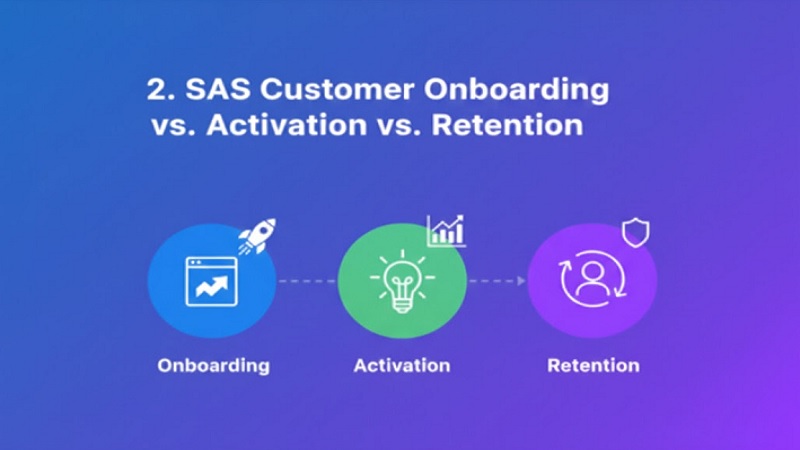
2. SaaS Customer Onboarding vs. Activation vs. Retention
Many teams use these terms interchangeably, but they solve very different problems.
Customer Onboarding
This is the user’s first structured journey through your product.
Activation
The moment a user experiences meaningful value.
Retention
When users return because they’ve already felt value.
Here’s the truth:
SaaS Customer Onboarding without activation is useless.
Research from Amplitude and OpenView shows activation strongly predicts long-term retention and revenue.
A 3-Tier Activation Taxonomy (New Perspective)
Most SaaS onboarding best practices stop at defining activation. Let’s go deeper.
- Functional activation – User completes a basic task
- Value activation – User experiences the core benefit
- Habit activation – User returns naturally
High-performing Onboarding is designed to move users to value activation as fast as possible.
3. The Psychology Behind Effective SaaS Customer Onboarding
Users don’t read manuals. They scan, hesitate, and feel overwhelmed.
According to Nielsen Norman Group, users read only 20–28% of on-screen content. That means Customer Onboarding must reduce cognitive load immediately.
Cognitive Load Theory in SaaS Onboarding
- Chunk information
- Prioritize early wins
- Sequence tasks intentionally
BJ Fogg’s Behavior Model (B = MAP)
Behavior happens when motivation, ability, and prompts align.
If motivation is low, SaaS onboarding must:
- Reduce effort
- Remove friction
- Guide action clearly
Emotional Design in SaaS Customer Onboarding
Effective onboarding makes users feel:
- Capable
- Curious
- Confident
Activation Triggers Most Teams Ignore
- Progress feedback loops
- Commitment cues
- Value anticipation hooks
These are rarely mentioned in SaaS onboarding best practices, but they drive behavior change.
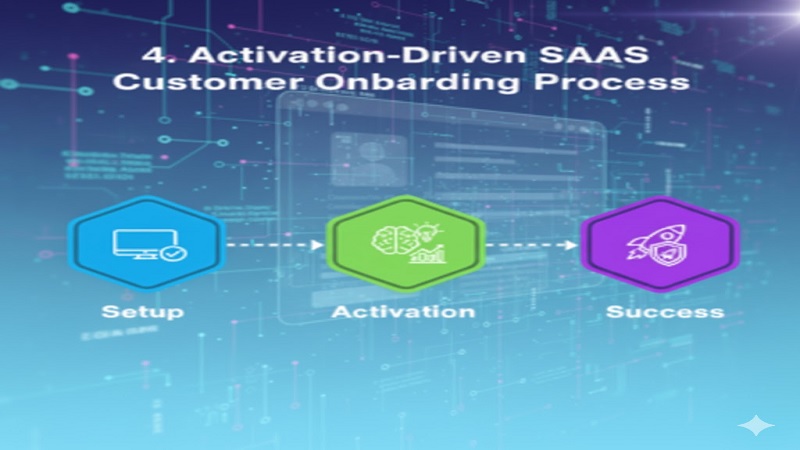
4. Activation-Driven SaaS Customer Onboarding Process
Let’s walk through a practical, real-world SaaS onboarding process.
a) Pre-Onboarding (Before Login)
Activation starts before the product.
- Clear value messaging
- Preboarding emails
- Expectation setting
This stage is often ignored in SaaS onboarding, yet it frames how users perceive value.
b) First Sign-In Experience
Your first screen should answer:
“What should I do first to get value?”
Best practices:
- Value-focused welcome screen
- Checklist limited to 3–5 steps
According to Appcues, checklists increase activation by up to 30% when done right.
c) Task Sequencing with Progress Feedback
Not all actions are equal.
High-impact SaaS Customer Onboarding:
- Prioritizes actions tied to value
- Shows progress visually
- Celebrates first wins
d) Contextual Help, Not Interruptions
Avoid modal overload.
Effective SaaS onboarding delivers:
- Just-in-time tips
- Behavior-triggered guidance
This approach aligns with modern SaaS onboarding best practices.
e) Social Proof at Moments of Hesitation
Users hesitate before committing.
Place:
- Testimonials near decision points
- Use-case proof tied to actions
This builds trust during Onboarding.
Advanced SaaS Onboarding Tactics (Rarely Covered)
- Dynamic tooltips triggered by hesitation
- Activation-based A/B testing
- Micro-surveys at drop-off moments
These tactics improve the onboarding process beyond surface-level optimization.
5. How to Avoid Common SaaS Customer Onboarding Mistakes
Common failures in Customer Onboarding include:
- Too many steps before value
- Teaching features instead of outcomes
- Ignoring user intent
- Relying on vanity metrics
Important Warning
Metrics like “tour completed” are not activations. Measure actions that lead to value instead.
6. SaaS Onboarding Checklist
A practical SaaS onboarding checklist for activation:
- Activation event clearly defined
- Preboarding sets expectations
- First session delivers value
- Guidance is contextual
- Progress is visible
- Social proof is intentional
Use this SaaS onboarding checklist to audit your flow quarterly.
7. SaaS Customer Onboarding Software & Personal Experience
Below are SaaS onboarding tools I’ve seen used effectively, along with where they work best and where teams often struggle.
What it does well
Appcues is one of the most widely adopted SaaS onboarding tools, especially among mid-market SaaS companies. It allows teams to build in-app flows, tooltips, banners, and checklists without heavy engineering involvement.
Key features
- In-app flows and walkthroughs
- Tooltips and modals
- Onboarding checklists
- Basic user segmentation
Best for
Mid-market SaaS teams that want to iterate quickly on onboarding without relying heavily on developers.
Advantages
- No-code setup enables fast experimentation
- Strong UI patterns for onboarding flows
- Easy to launch A/B tests for onboarding content
Limitations
- Can lead to over-communication if not governed by strategy
- Teams often focus on “tour completion” instead of activation
- Limited depth in behavioral analytics compared to more advanced tools
Real-world insight
Appcues works best when teams define one clear activation goal and design flows backward from that. Without discipline, it’s easy to clutter the product with too many prompts.
What it does well
Userpilot is more activation-focused than most SaaS onboarding software. It emphasizes behavior-based triggers and contextual guidance, making it ideal for teams optimizing activation and feature adoption.
Key features
- Behavior-based onboarding flows
- Advanced user segmentation
- In-app analytics tied to feature usage
- Contextual tooltips and modals
Best for
SaaS teams that already understand their activation metrics and want to improve them through targeted SaaS customer onboarding.
Advantages
- Strong segmentation enables personalized onboarding
- Guidance appears based on real user behavior
- Better alignment with activation metrics
Limitations
- Slight learning curve for non-technical teams
- Requires upfront thinking about events and tracking
Real-world insight
Userpilot shines when onboarding is treated as a continuous optimization process, not a one-time setup. Teams that invest time in defining activation triggers see the highest ROI.
What it does well
Pendo combines product analytics with SaaS onboarding tools, making it popular among enterprise SaaS organizations. It provides deep insight into user behavior alongside onboarding capabilities.
Key features
- Product usage analytics
- In-app guides and walkthroughs
- Feedback collection
- Roadmap and feature adoption tracking
Best for
Enterprise SaaS teams with complex products and multiple personas.
Advantages
- Deep behavioral data across the product
- Strong analytics for identifying friction points
- Suitable for large, multi-team environments
Limitations
- High cost compared to other SaaS onboarding software
- Setup and configuration can be time-intensive
- Less flexible for rapid onboarding experiments
Real-world insight
Pendo is most effective when onboarding decisions are data-led. It’s not ideal for early-stage SaaS but powerful for scaling onboarding at enterprise level.
Intercom (Product Tours & In-App Messaging)
What it does well
Intercom is primarily a customer communication platform, but many teams use it as part of their customer onboarding stack, especially for support-led onboarding.
Key features
- In-app messaging
- Product tours
- Onboarding messages and nudges
- Customer support integration
Best for
SaaS companies where onboarding is closely tied to customer success or sales-assisted activation.
Advantages
- Strong conversational onboarding capabilities
- Easy to trigger messages based on lifecycle stage
- Seamless support + onboarding experience
Limitations
- Limited activation analytics
- Not designed as a full SaaS onboarding platform
- Product tours are relatively basic
Real-world insight
Intercom works best as a supporting tool, not the core SaaS onboarding software. It’s effective for nudges, reminders, and human-assisted activation moments.
My Personal Experience
From working closely with multiple SaaS teams, ranging from early-stage startups to mature SaaS companies, the biggest onboarding failures rarely come from a lack of tools. They come from lack of clarity.
Most teams adopt SaaS customer onboarding software hoping it will “fix onboarding.” But tools don’t create activation, strategy does. Software only accelerates what already exists. If your activation moment is unclear, no onboarding platform will save you.
That said, when used intentionally, the right SaaS onboarding software can dramatically reduce time-to-value, surface friction points, and enable continuous experimentation. The key is choosing tools that support behavior-driven onboarding, not just static product tours.
How to Choose the Right SaaS Onboarding Software
When selecting SaaS onboarding tools, ask these questions:
- Do we clearly know our activation event?
- Can this tool trigger guidance based on user behavior?
- Does it help reduce time-to-value?
- Can we measure activation impact, not just engagement?
The best SaaS customer onboarding software doesn’t overwhelm users. It quietly removes friction and guides them toward value at the right moment.
8. Case Examples of SaaS Customer Onboarding
Example 1: CRM SaaS
Users are prompted to create their first contact within 10 minutes, triggering value activation immediately.
Example 2: Analytics SaaS
Users upload data first. The dashboard auto-generates insights, value before explanation.
Failing Flow → Fixed
Failing: Long tour before action
Fixed: One task → visible result → celebration → next value preview
This is SaaS Onboarding done right.
9. Conclusion: The Future of SaaS Customer Onboarding
SaaS Customer Onboarding is not about adding more steps, It’s about accelerating value.
If users don’t experience value quickly, retention won’t save you.
Next steps:
- Define your real activation event
- Audit the first 15 minutes
- Improve one onboarding element every week
The best SaaS onboarding doesn’t explain, It activates.
